
Avoid These 6 Electric Scooter Riding Mistakes! points out simple but risky habits that can make your rides less safe and less fun. Follow the quick tips to improve your stance, braking, and setup so you ride with more control and confidence.
The video and guide cover incorrect foot and body positioning, one-hand braking, one-hand riding, poor riding surfaces, and improper scooter setup, with practical fixes for each. Whether you’re just starting or sharpening your skills, you’ll get clear steps to reduce falls, boost control, and pick useful accessories.

Incorrect Foot Positioning
Electric scooter control starts with where you put your feet. Poor foot placement undermines balance, makes acceleration and braking unpredictable, and increases the chance you’ll catch an edge or lose control. Paying attention to small adjustments will give you much more confidence and safer rides.
Why improper foot placement reduces control and balance
If your feet are too close together, too far back, or both angled awkwardly, you reduce your ability to react to bumps, steer precisely, and shift weight quickly. A foot placed too far forward can catch the front wheel when turning; a foot too far back lowers stability and makes braking jerky. Uneven foot spacing also makes it harder to absorb shocks and maintain a centered balance point, so you’ll feel less composed when changing speed or direction.
Correct feet arrangement for stability during acceleration and braking
For most riders, the most stable arrangement is a staggered stance: place your front foot roughly centered on the deck with the toes pointing forward or slightly outward, and set your rear foot perpendicular or slightly angled on the deck to the rear. Your front foot should be near the middle-to-front third of the deck to give you leverage when steering, while your rear foot provides braking control and a stable platform. Keep your feet about shoulder-width apart if the deck allows — that width gives you lateral stability without limiting movement.
How to transition feet when mounting, dismounting, and pushing off
When mounting, step onto the deck with your strongest foot first (usually the front foot), then bring the other behind you into the staggered stance. When dismounting, slow down, shift weight slightly to the rear foot, then step off with your rear foot first to maintain balance. When pushing off, keep your pushing leg relaxed and heel-down for control; after the push, place it back on the deck smoothly to avoid causing a wobble. Practice mounting and dismounting slowly in a safe area until the movements feel natural.
Common beginner habits to break and drills to practice proper placement
Beginners often stand with feet too close together, square to the deck, or too far back. Break these habits by practicing: 1) slow figure-eights while focusing on keeping your front foot centered; 2) short acceleration and stop drills where you consciously place feet in the staggered stance; 3) one-foot balance drills on a stationary scooter (with support nearby). Start at walking speeds and gradually increase as the stance becomes second nature.
Adjusting stance for different scooter deck sizes and rider heights
Deck width and length change how you place your feet. Narrow decks require you to center your feet more and rely on subtle hip adjustments for balance. Longer decks let you spread your feet wider for stability. Taller riders may want a slightly longer wheelbase and a bit more distance between feet to lower knee and hip strain. Test different positions on your deck to find the stance that lets you shift weight easily and reach controls comfortably.
Incorrect Body Positioning
Body position determines how well you steer, brake, and react. Small alignment adjustments in your hips, shoulders, and head will make handling more predictable and put less strain on your body during longer rides.
How upper- and lower-body alignment affects handling and responsiveness
Your upper and lower body should move as a coordinated unit. If your shoulders are twisted away from your hips, steering input becomes delayed and imprecise. If your hips are rigid, you lose the ability to absorb bumps and make subtle weight shifts that aid turning. Align your head, shoulders, hips, and feet facing the direction of travel to maximize responsiveness and make the scooter react predictably.
Proper weight distribution for straight-line riding, cornering, and hill climbs
For straight-line riding, keep your weight centered slightly forward of the deck’s midpoint for control and traction. When cornering, shift your weight into the turn — lean your upper body and hips slightly toward the inside of the curve while keeping your eyes on the exit. For hill climbs, move your weight forward to avoid the front wheel lifting and to maintain steering authority; for downhill, shift your weight rearward to prevent overpowering the front brake and to keep traction.
How to lean safely into turns without compromising traction
Lean from the hips, not just the shoulders, and keep your outside foot slightly pressed down to stabilize the deck. Avoid exaggerated upper-body lean that lifts the inside wheel or shifts too much weight off the rear tire. Enter turns at a controlled speed, pick a line, and apply gentle counter-steering if needed. If the surface is low-grip (wet, gravel), reduce lean and speed to maintain traction.
Posture tips to reduce fatigue and improve visibility
Keep a slight bend in your knees and elbows — this acts as suspension and reduces fatigue. Don’t lock your back; maintain a neutral spine and keep your head upright to scan the road. Hold the bars lightly but securely; a death grip tires your forearms and reduces feel. Good posture improves visibility of hazards and helps you react faster.
Adapting body position for different speeds and road conditions
At higher speeds, bring your center of gravity lower and slightly forward to improve aerodynamics and stability. On rough roads, stand slightly more upright with knees bent to absorb impacts. In crowded areas, ride with a relaxed posture and lower speeds to allow quick, controlled inputs. Always tailor your body position to what the environment demands.
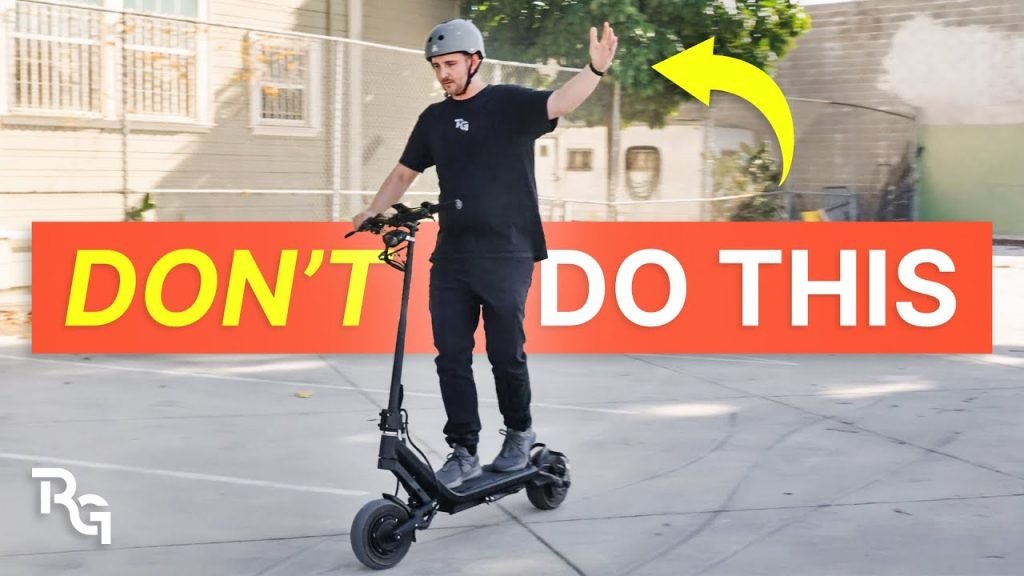

One Hand Braking
Using one hand to brake may seem convenient, but it compromises safety. You need the full control and braking power of both hands in many emergency scenarios.
Why relying on a single brake or one-handed braking is risky
One-handed braking limits how much force you can apply safely, increases stopping distance, and reduces steering control. If you rely on a single brake and it fails or the tire locks, you have fewer options to recover. That single-hand habit also makes it harder to modulate braking between the front and rear systems, which is essential for balanced stops.
Safe braking technique using both hands and both brakes when available
Place both hands on the handlebars whenever possible and use both brakes together: gentle, progressive pressure on the front brake accompanied by rear brake application helps shorten stopping distance while keeping the scooter stable. If your scooter has a regenerative system plus a mechanical brake, use the mechanical brake for strong deceleration and the regen as a complement rather than a sole stopping method.
How to modulate braking force to avoid skids and loss of control
Squeeze brakes progressively rather than slamming them. Start with moderate pressure to transfer weight rearward, then increase pressure as the scooter slows. If the front wheel shows signs of locking or wobbling, ease off slightly and focus more on the rear brake. Practicing in an empty parking lot helps you learn the thresholds for lockup and the balance point between both brakes.
Emergency braking sequence and when to apply each brake
In an emergency, shift your weight back, keep your arms relaxed but firm, and apply both brakes progressively — front first for most of the stopping power, rear to stabilize. If you have to choose quickly, the rear brake can help prevent a forward flip on steep stops, while the front brake offers the most stopping power on level ground. Avoid full, instantaneous front-brake grabs unless you are practiced and on high-traction surfaces.
Practice exercises to build confidence in two-handed braking
Practice controlled stops from varying speeds while consciously using both hands and both brakes. Do interval drills: accelerate to a set speed, then brake to a stop using both brakes, noting distance and feel. Also practice emergency stops and partial-lock scenarios in a safe area so you can recognize and correct wheel lockup without panic.
One Hand Riding
Riding with one hand may seem casual, but it reduces precision and increases fall risk. Learn when it might be unavoidable and how to handle those moments safely.
How riding with only one hand reduces steering precision and increases fall risk
One-handed grips weaken your steering input and make sudden corrections jerky. You lose the damping effect provided by two hands, making the scooter more prone to wobble when hitting bumps. With only one hand, your ability to react to sudden obstacles or to modulate brakes quickly is reduced, which raises collision and fall risks.
Situations where one-handed riding might be unavoidable and safer alternatives
You might need one hand free to signal, grab a quick item, or briefly adjust clothing. Safer alternatives include stopping to make adjustments, using a crossbody bag or backpack for items, or using voice commands on a phone with a secure mount. If you must use one hand briefly, slow down and shift your weight low to compensate.
Techniques for keeping control if you must briefly use one hand
If you must ride one-handed for a short moment, keep your elbow bent, maintain a firm but relaxed grip with the other hand, and lower your center of gravity slightly by bending your knees. Keep your free hand close to your body to avoid sudden weight shifts, and avoid steering or braking hard until you regain two-handed control.
Why stable handlebar grip and wrist position matter
A stable, neutral wrist position reduces arm fatigue and improves fine steering control. Holding the bar too tight or with a twisted wrist reduces tactile feedback and can cause numbness or loss of control over longer rides. Maintain a relaxed, overhand grip that lets your wrists move naturally with steering inputs.
Tips for carrying items safely without compromising both-hands control
Use a backpack, crossbody bag, or securely mounted basket rather than carrying things in your hands. If you must carry something in one hand briefly, stop to stash it securely or use a hip-mounted clip. Keep bulky items low and centered to avoid unbalancing the scooter.
Poor Riding Surfaces
Poor surfaces are one of the biggest causes of unexpected falls. Being able to identify hazards and pick safe lines is a core skill for safe riding.
Identifying hazardous surfaces such as gravel, wet leaves, potholes, and metal grates
Look out for loose gravel, wet leaves, oil slicks, potholes, deep puddles, and metal grates. Each can affect traction differently: gravel tends to shift under tires, wet leaves can be as slippery as ice, and metal surfaces are slick when wet. Potholes can cause wheel damage or sudden jolts that throw you off balance.
How to scan ahead and choose a safer line through tricky patches
Scan the road at least several meters ahead and pick a line that avoids hazards or crosses them at an angle that minimizes impact. Slow down before tricky patches rather than mid-patch. When you must cross an uneven surface, approach perpendicular to reduce the chance of a wheel dropping into a hole or catching an edge.
Speed and posture adjustments for uneven or slippery ground
Reduce speed and keep a loose, slightly upright posture with knees bent to act as suspension. Avoid sudden braking or sharp turns on slippery surfaces. Instead, use gentle, progressive inputs and shift weight slightly rearward to keep the front wheel from washing out.
Tire and suspension choices that improve traction and comfort
Wider tires with good tread provide better grip on loose or wet surfaces. If your scooter has adjustable suspension, soften it slightly for better compliance over bumps while avoiding too much squat that affects handling. Air-filled tires offer damping that solid tires lack, so consider tire choice based on the surfaces you ride most.
When to dismount and walk the scooter for safety
If a surface looks particularly hazardous (ice, deep gravel, steep cobblestones, or unfamiliar construction zones), dismount and walk. When visibility is poor or you can’t pick a safe line, walking the scooter is the fastest way to prevent an accident.
Incorrect Scooter Setup
A poorly set-up scooter compromises safety and comfort. Regular adjustments and checks keep the machine predictable and reliable.
Importance of proper handlebar height, stem tightness, and deck clearance
Set handlebar height so your elbows are slightly bent and your shoulders are relaxed; too high or too low causes strain and reduces control. Ensure the stem is tightened to prevent twisting during turns. Deck clearance matters to avoid scraping on curbs; if the deck sits too low you may bottom out in uneven areas.
How to set and check tire pressure, brake adjustment, and suspension (if equipped)
Inflate tires to the manufacturer’s recommended pressure for the load you carry — underinflation increases rolling resistance and reduces handling, overinflation reduces traction. Check brakes for pad wear, proper cable tension, and even engagement between front and rear. If you have suspension, check sag and rebound settings (if adjustable) for your weight and typical terrain.
Ensuring lights, reflectors, and mirrors are correctly positioned and functional
Position lights so they’re visible to others and illuminate your path without blinding oncoming traffic. Make sure reflectors are clean and mirrors are set for an unobstructed rear view. Test electronics before you ride to ensure batteries are charged and lights function properly.
Firmware and software tips: why keeping your scooter updated matters
Many modern scooters use firmware for throttle response, regenerative braking, and safety limits. Firmware updates can improve responsiveness, fix bugs, and enhance safety features. Check your manufacturer’s guidance and apply updates regularly, making sure to follow any instructions to avoid bricking devices.
Simple pre-ride checks to prevent failures while riding
Before you ride, do a quick walkaround: check tire pressure, brakes, lights, stem tightness, and that the deck is clean of debris. Test-ride at low speed for brakes and steering response. These small checks prevent most preventable failures.
Ignoring Protective Gear
Protective gear is not optional — it’s the difference between a scrape and a serious injury. Make it part of your routine.
Why a certified helmet is the single most important safety item
A certified helmet protects your brain from impacts and dramatically reduces the risk of traumatic brain injury. Choose a helmet that meets recognized standards, fits snugly, and is worn every ride. Even low-speed falls can cause head injury, so make wearing a helmet your baseline habit.
Benefits of gloves, knee and elbow protection, and sturdy footwear
Gloves protect your palms from abrasions and improve grip on the bars; knee and elbow pads reduce the severity of joint injuries in falls, especially for commuting in busy areas. Sturdy, closed-toe shoes with good grip keep your feet secure on the deck and protect toes from abrasion or impact.
Visibility enhancements: reflective clothing and lights for low-light riding
Reflective vests, ankle bands, and bright clothing make you more visible to drivers and pedestrians. Use front and rear lights even at dusk to increase conspicuity. Remember that being seen is as important as seeing.
How to fit and care for protective gear to ensure ongoing protection
Ensure helmets sit level and strap tightly under your chin; gloves should fit snugly to avoid bunching. Clean gear as recommended by the manufacturer and replace any item that’s taken a significant impact or shows signs of wear. Properly maintained gear provides consistent protection.
Common excuses riders use to skip gear and practical ways to overcome them
Excuses like “it’s too short,” “it’s too hot,” or “I’m just going around the corner” are common. Make gear convenient: keep a helmet at work, choose ventilated protective clothing, and train yourself to put gear on as part of leaving the house. Think of gear as essential equipment, not optional extras.
Overestimating Speed and Capability
Speed can feel exhilarating, but it increases risk. Knowing your limits and how speed affects handling will keep you safer and more in control.
Understanding personal limits and how speed affects reaction time
As speed increases, your reaction window shrinks and stopping distance grows. Higher speed magnifies small mistakes into big consequences. Be honest about your skill level and build speed gradually while practicing in safe areas to expand your comfort zone.
How scooter performance, rider weight, and cargo change handling
A heavier rider or extra cargo increases stopping distance, reduces acceleration, and can change the scooter’s center of gravity. High-powered scooters may accelerate much faster than you expect, which can cause instability if you’re unprepared. Adjust your speed and riding style to account for weight and payload.
Choosing appropriate speeds for traffic, pedestrians, and road conditions
In crowded or mixed-use areas, slow to walking pace when necessary and keep speeds conservative near pedestrians. On open bike lanes or roads with fewer obstacles, you can safely ride faster but still within your skill set and legal limits. Always reduce speed on wet or uneven surfaces.
Safe overtaking and passing practices to reduce collision risk
When passing pedestrians or slower riders, signal early, slow down slightly, and give a wide berth. Overtake on the left (or the local practice) when it’s safe and avoid passing on the right, near parked cars, or in blind spots. Announce your intention verbally if approaching pedestrians from behind.
Using speed modes responsibly and the benefits of gradual speed increases
Many scooters offer multiple speed modes. Start in the lowest mode to learn throttle response and only shift modes as you become comfortable. Gradual increases allow you to build skill, confidence, and an understanding of braking at higher speeds.
Poor Braking and Emergency Maneuvers
How you brake and maneuver in emergencies determines whether an incident ends as a close call or a crash. Practice and technique protect you more than raw speed.
Common braking mistakes that lead to loss of control
Common errors include grabbing the front brake too hard, relying only on one brake, locking wheels, and braking late while turning. These mistakes can cause slides, washouts, or forward flips. Learning progressive braking and weight shifting prevents most of these issues.
Step-by-step emergency stop technique and when to use it
To execute an emergency stop: 1) Shrink your body slightly and shift weight rearward; 2) Apply both brakes progressively, front slightly before the rear on level ground; 3) Keep your arms relaxed to absorb forces; 4) If the front wheel begins to wash out, ease pressure and let the rear contribute more. Use this sequence when a sudden obstacle appears and you must stop quickly.
How to practice evasive maneuvers and controlled swerves safely
Find a traffic-free area and practice quick left-right swerves at moderate speed while maintaining balance and control. Start slow and progressively increase speed. Focus on looking through the direction you want to go and letting your hips and shoulders lead the movement rather than jerking the bars.
Understanding and avoiding rear-wheel lock and front-wheel washout
Rear-wheel lock occurs when you use too much rear braking on a low-traction surface, causing the wheel to skid. Front-wheel washout happens when the front tire loses grip (often due to over-braking or leaning too much). Avoid both by braking progressively, shifting weight appropriately, and reducing speed before turns.
Role of ABS and electronic systems versus rider technique
ABS and electronic aids can help prevent wheel lockup in some scooters, but they don’t replace good technique. Rely on technology as a backup and maintain proper riding fundamentals: weight shift, progressive braking, and awareness. Know what your scooter’s systems do and how they change braking feel.
Conclusion
This wrap-up reinforces the key mistakes and what to do instead, encouraging consistent safety habits.
Recap of the most common mistakes and how to avoid them
The most common errors are poor foot and body positioning, one-handed braking and riding, ignoring hazardous surfaces, incorrect scooter setup, skipping protective gear, overestimating speed, and bad braking technique. You avoid these by adopting a stable stance, using both hands and brakes, scanning surfaces and choosing lines, performing pre-ride checks, wearing appropriate protective gear, respecting your limits, and practicing emergency maneuvers.
Encouragement to use protective gear, perform pre-ride checks, and practice regularly
Make helmet use, pre-ride checks, and short practice sessions part of your routine. Regular, deliberate practice builds muscle memory and reduces the chance of panic in real situations. Treat safety habits the same way you would tune a vehicle: a little effort prevents big problems.
Final reminder to respect local rules and ride within your limits
Always follow local laws, be courteous to pedestrians and other road users, and ride within your skill and equipment limits. Pushing boundaries is how you improve, but do so gradually and in controlled environments. With good habits and regular practice, you’ll enjoy safer, more confident rides.
Electric scooter riding is not overly complicated, but there are a few common mistakes I often see new riders making when starting out on an electric kick scooter. I’ll go over the 6 most common ones I see and how to avoid them. This guide will be helpful for both new and experienced riders looking to make sure they are riding properly and safely.
Scooters used in making this video👇🏼
🛴Apollo Air 2023-
🎟️Use Code RIDERGUIDE for $50 OFF
🛴Emove Cruiser-
🎟️Use Code RIDERGUIDE for $50 OFF
🛴Nami Klima-
🎟️Use Code RIDERGUIDE100 for $100 OFF
🛴Inmotion RS-
🎟️Use Code RGMIDNIGHT for $500 OFF
🛴Gotrax G3 Plus –
🎟️Use Code RIDERGUIDE25 for $25 OFF
🚨RECOMMENDED ACCESSORIES
🔦Shredlights-
🎟️Get 10% OFF with Code RG10
🛞Armor-Dilloz Tire Sealant-
🎟️Get 10% OFF with Code RG10
⛑️Best Helmet List-
🏬ESG Amazon Store-
ELECTRIC SCOOTER LINKS
➡️ Best Scooter List :
➡️ Scooter Reviews:
➡️ Buying Guide:
➡️ Ride Finder:
🚨Please subscribe to both of our Youtube Channels and Turn on Notifications for all up to date content.
/ @riderguide
/ @esg-electricscooterguide
🌐Website-
🌐Website-
📸 Instagram-
💬 FB Group-
Chapters
